
Team building games that nobody has to pretend to enjoy.
The phrase "team building games" makes half your office flinch, and they have earned that flinch through years of two truths and a lie. Good games exist. They just follow different rules.
A game earns its place in the office when it has a real objective, teams instead of spotlights, and a clock. Icebreakers fail because they point attention at individuals. Games work because they point attention at a task. Nobody feels observed while trying to win.
Thirty minutes, zero budget
For a Friday afternoon or a sluggish offsite block, short rounds do the job: a paper-tower build-off between departments, a photo scavenger hunt around the office, a timed quiz where every team needs one answer from every member. The pattern in all three: mixed teams, visible score, hard time limit. Fifteen people who spent half an hour losing together talk more afterwards than any icebreaker circle achieves.
The full-size version: captain's ball
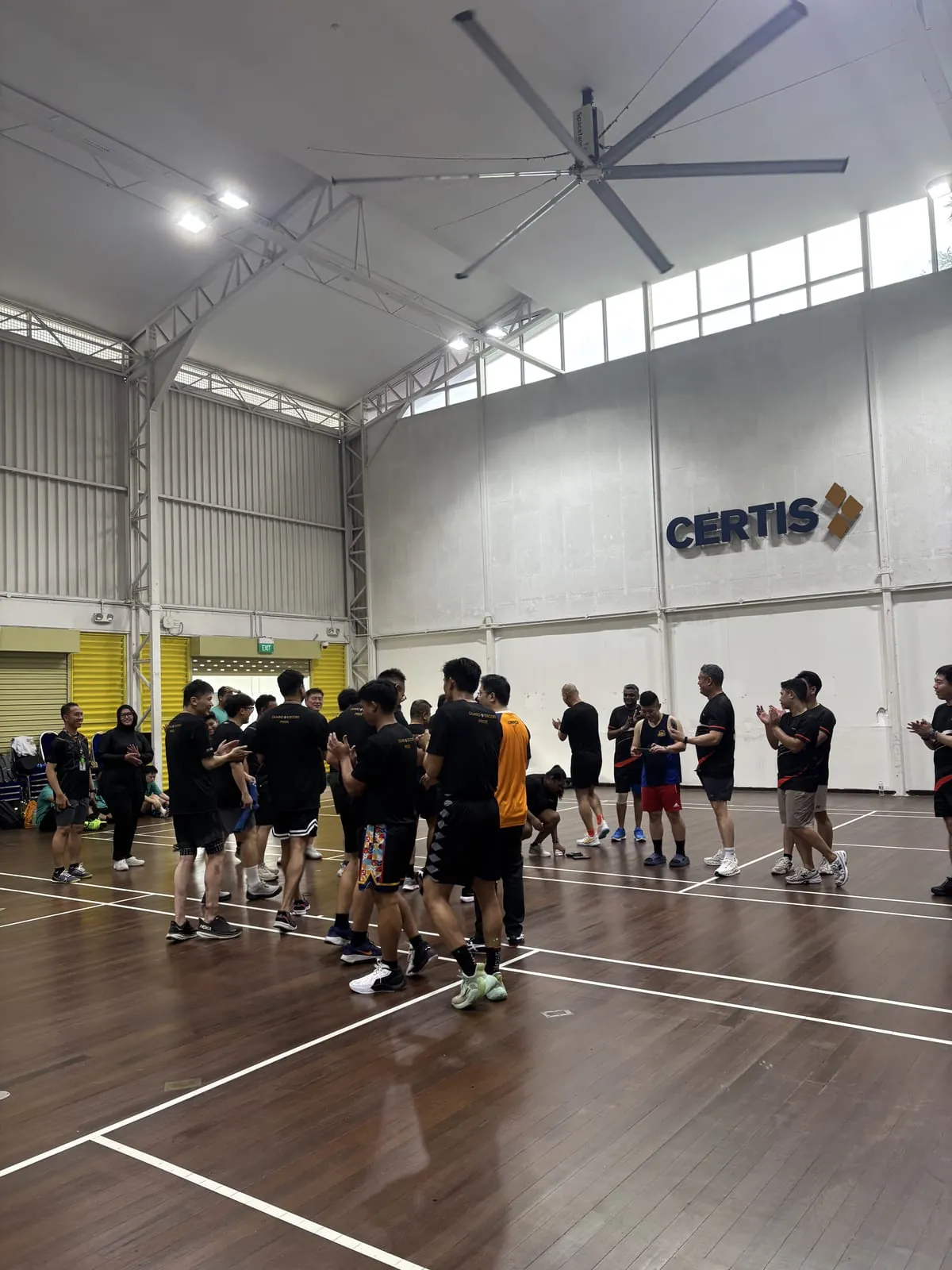
When a company wants the real thing, captain's ball is Singapore's default for a reason. Simple rules, any fitness level, and it scales past a hundred players. We sponsored a corporate captain's ball day for Certis and watched departments that barely email each other trash-talk across a court by round two. That is the entire theory of team sport as team building, demonstrated in one afternoon.
Big-group games need what small games do not: a coordinator, marshals, brackets and a wet-weather plan. That is the point where it stops being a DIY job, and it is exactly the kind of custom team bonding day we build and run end to end.
Running a 30-minute round well
Small games fail on mechanics, not on choice of game. Draw the teams randomly and publicly, never let departments self-sort, because self-sorted teams defeat the purpose before the timer starts. Put the score somewhere everyone can see it; a whiteboard changes behaviour in a way a quiet tally never does. And spend twenty dollars on a trophy. A ridiculous physical trophy that lives on the winning team's shelf until the rematch generates more energy than any voucher, because it keeps the game alive between rounds.
Time-box ruthlessly. Thirty minutes with a countdown produces urgency; forty-five without one produces phone-checking. End at the peak, announce the rematch, and attendance for the next round takes care of itself.
Games are a doorway, not the destination
A good game session often becomes the argument for a proper team day. If the energy is there, point it somewhere: a golf clinic for the competitive crowd, art jamming for the creative one, or a full sports day if the office wants a rematch at scale.
Common questions
Captain's ball is the standard: simple rules, all fitness levels, and it scales beyond a hundred people with proper brackets. Station-based game circuits also work well for mixed large groups, run by a coordinator with marshals.
Spotlighting individuals. Games that force personal sharing or put one person on stage create dread. Games with a team objective, a score and a timer put attention on the task instead, which is why nobody minds them.
Short-format games, yes: build-offs, scavenger hunts and quiz rounds run fine with meeting rooms and 30 minutes. Court games like captain's ball need a proper venue, which an organiser books as part of a custom day.
Want the full-size version?
From office game rounds to a bracketed captain's ball tournament, tell us the headcount and the energy level. We build the day, you play in it.
Build a custom day